 F&Bos
Recipe Management Software for Smarter Restaurant Operations
F&Bos recipe management software gives every dish one standard recipe: ingredients, quantities, units, sub-recipes and method. For owners, chefs and kitchen managers, recipes are linked to stock, so each bill deducts what the kitchen should have used.
What is recipe management software?
Recipe management software keeps one agreed record of every dish: its ingredients, quantities, units, batch preparations and method, so each cook makes it the same way. Recipe costing is a different job: it puts prices on those quantities to work out what a plate costs.
In F&Bos, recipes sit inside the POS. Each menu item and variant has its own recipe, built from your stock items, so billing the dish deducts its ingredients.
Why restaurants need recipe management software
- Recipes live in heads and notebooks, so one cook uses 120 g of paneer and another 150 g.
- Duplicate items: "Paneer" and "PANEER 1KG" become two.
- Units don't match: rice is bought in kilos but used in grams.
- Recipes and stock are kept apart, so nobody knows what the kitchen should have used.
Key features of F&Bos recipe management software
Standard recipe for every item
Ingredients, quantities and method for each dish and variant, such as half and full plates. Sort recipes into categories, or copy one to start a similar dish.
Batch prep and sub-recipes
Gravies and doughs made in batches use their raw ingredients and add the prepared item to stock; each dish then uses its share.
Purchase and recipe units
Buy rice by the kilo and use 120 g in a recipe. F&Bos converts between the purchase unit and the recipe unit automatically.
Ingredients linked to stock
Recipe ingredients are your inventory items, and every bill deducts them.
One recipe set or outlet recipes
Share one recipe set across outlets, or keep outlet-specific recipes where a dish differs.
Data clean-up in assisted setup
Our team standardises ingredient names, fixes units, removes duplicate items and maps your recipes to stock as part of assisted setup.
Source: F&Bos product team, 23 November 2026.
How recipe management connects with restaurant inventory
e.g. Paneer butter masala, full
Ingredients, sub-recipes, quantities, method
Unit, cost per unit, yield factor, stock on hand
Deducts the recipe's ingredients from stock
- Add ingredients as stock items with their purchase unit, category, cost per unit and yield factor.
- Build sub-recipes for batch items such as gravies.
- Write the recipe for each menu item and variant, picking ingredients and quantities in recipe units.
- Bill as usual. Each sale deducts its ingredients; bills made offline deduct when they sync.
- Review low-stock alerts, wastage and ideal vs actual usage in restaurant inventory management.
Where recipes and ingredients live in F&Bos
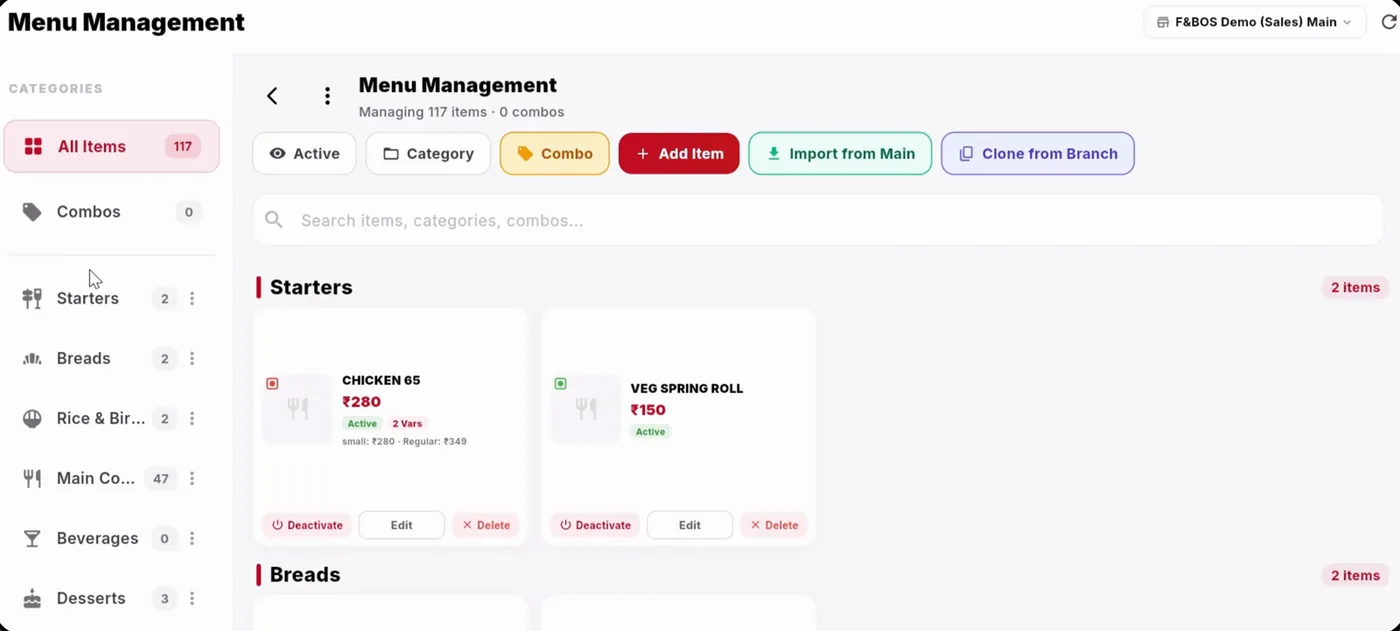
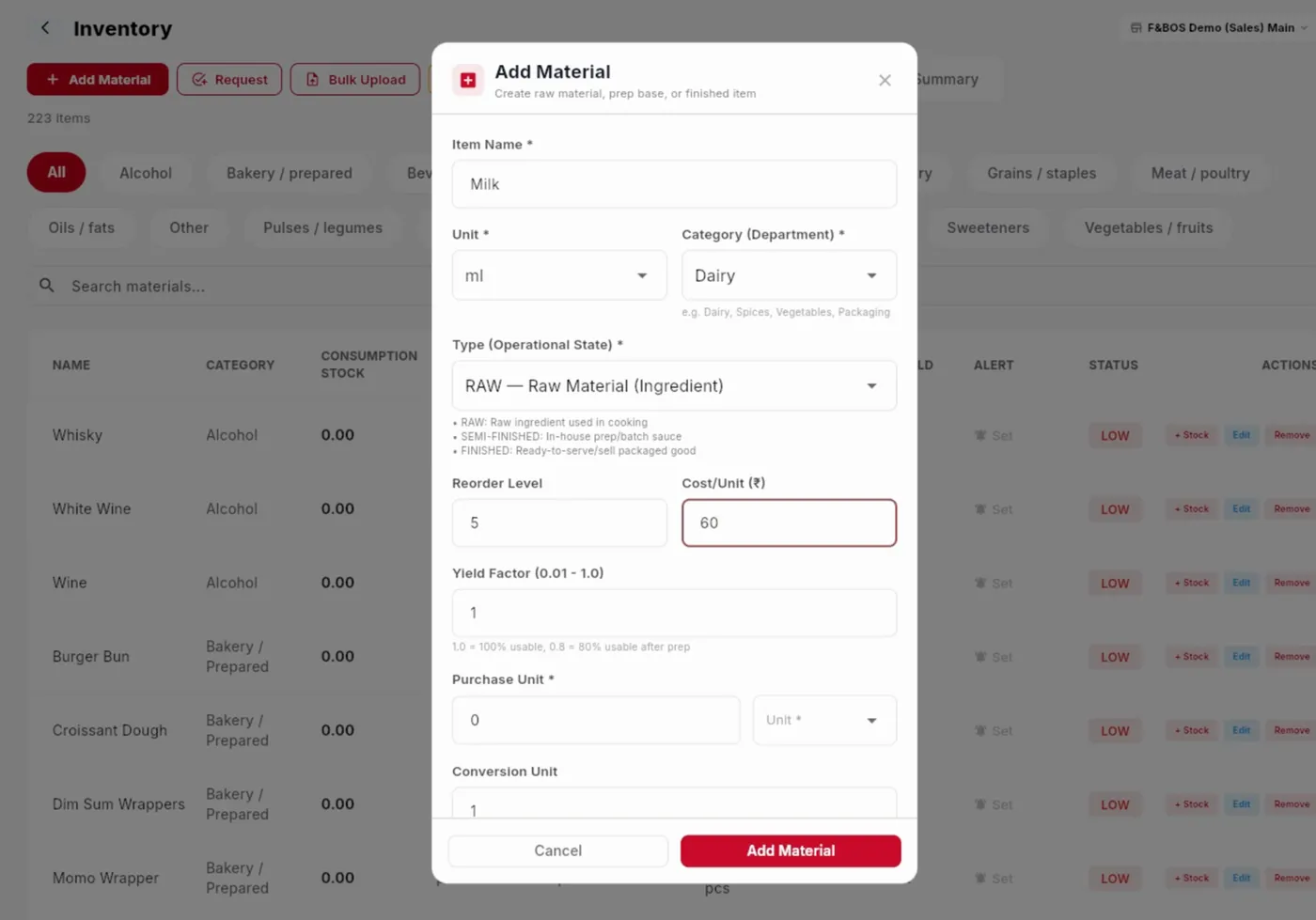
Real screens from F&Bos, taken from our setup videos.
Restaurant recipe card template: example and essential fields
A recipe card puts the name, yield, ingredients, quantities and method on one sheet, so every cook works from the same version:
Recipe name: Vegetable fried rice · Code: SAMPLE-001
Yield: 2 portions · Category: Rice and noodles
| Ingredient | Quantity | Unit |
|---|---|---|
| Cooked rice | 300 | g |
| Mixed vegetables | 150 | g |
| Cooking oil | 20 | ml |
| Soy sauce | 15 | ml |
| Salt | As required | — |
Method: Heat oil, stir-fry vegetables on high heat for 2 minutes, add rice and soy sauce, toss for 2 minutes, season and serve.
Illustrative recipe card, not an F&Bos screen or export. In F&Bos the same fields are kept on the recipe. To put prices on a card, see our recipe cost card guide.
Recipe management vs recipe costing software
| Area | Recipe management | Recipe costing |
|---|---|---|
| Purpose | One standard way to make each dish | What each dish costs and earns |
| Quantities | Recorded for the kitchen | Multiplied by ingredient prices |
| Stock | Ingredients linked to stock items | Uses their purchase prices and yields |
| Output | Recipe records and stock deduction | Cost per plate, food cost % and margin |
F&Bos does both from the same recipes. Learn more about F&Bos recipe costing software, including yields, purchase price history and per-dish margins.
How ingredient quantities affect recipe costs
Illustrative prices: a dish using 200 g of rice at ₹60/kg (₹12), 100 g of vegetables at ₹80/kg (₹8) and 20 ml of oil at ₹150/litre (₹3) has ₹23 of listed ingredients. A full dish cost also needs every other ingredient, yield loss and wastage, which is what recipe costing covers.
Organise recipe and ingredient data before implementation
Clean-up is part of assisted setup. Our team:
- standardises ingredient names and merges duplicates,
- sets purchase and recipe units,
- maps each recipe's ingredients to stock items.
You send your ingredient list and recipes; your chef confirms quantities and yields. Assisted setup with inventory is ₹3,000 per outlet once on Pro and ₹3,000–5,000 on Enterprise, plus GST. Self-setup is free. See pricing.
Who can benefit from restaurant recipe management software?
Independent restaurants: one written standard instead of the head cook's memory.
Cafés: fixed grams of beans and millilitres of milk per cup. See café POS software.
Cloud kitchens: the same portion on every delivery order, across brands. See cloud kitchen software.
Multi-outlet groups: one recipe set shared across outlets, with local exceptions.
F&Bos recipe management software pricing
| Plan | Recipes and recipe-linked inventory | Per-dish margins (MarginMind) | Per outlet per year |
|---|---|---|---|
| Basic (up to 50 menu items) | ₹3,500-a-year pack | Not stated | ₹6,000 |
| Pro | Included | Included | ₹15,000 |
| Enterprise (3+ outlets) | Included | Included | ₹24,000 |
Source: F&Bos pricing, 23 November 2026. Plus 18% GST. See features by plan.
F&Bos recipe management vs manual recipe records
| Area | Notebook or spreadsheet | F&Bos |
|---|---|---|
| Recipe records | Works if one person keeps it current | One record per item and variant |
| Batch prep | Separate sheets | Sub-recipes add prepared stock |
| Units | Converted by hand | Purchase-to-recipe conversion |
| Link to stock | Matched by hand, if at all | Every bill deducts ingredients |
| Changes across outlets | Re-sent to each kitchen | Shared recipe set or outlet recipes |
| Cost | Free | From ₹9,500 a year (Basic + inventory pack) + GST |
A spreadsheet suits a short, stable menu.
Frequently asked questions about recipe management software
What is recipe management software?
Software that keeps one standard record of each dish's ingredients, quantities, units and method, so it is made the same way every time.
How does recipe management help restaurants?
It keeps portions consistent between cooks and outlets, and in a POS like F&Bos it also drives stock deduction on every bill.
Can F&Bos link recipes with inventory items?
Yes. Recipe ingredients are stock items, and each bill deducts them. Sub-recipes add prepared items such as gravies to stock.
Does F&Bos automatically calculate recipe costs?
Yes, from ingredient purchase prices and yields. Per-dish margins are in Pro and Enterprise. See recipe costing software.
Can I keep standard ingredient quantities in F&Bos?
Yes. Each recipe holds quantities in recipe units such as grams or millilitres, converted automatically from the purchase unit.
What is a restaurant recipe card template?
A one-page format with the dish name, yield, ingredients, quantities, units and method. See the example on this page.
Does F&Bos provide recipe or inventory data clean-up?
Yes, as part of assisted setup: ingredient names, units, duplicates and recipe-to-stock mapping. Your chef confirms quantities.
How can I book a demo of F&Bos recipe management?
Book a free 20-minute demo or WhatsApp +91 79803 72217. Bring two or three of your recipes.
Bring more structure to your restaurant recipes
See your own dishes set up as F&Bos recipes in a free 20-minute demo, or explore recipe costing.
Book Your Free Demo →Free 20-minute demo · Free self-setup, or assisted setup from ₹2,000 · WhatsApp: +91 79803 72217