 F&Bos
Recipe costing software that shows the profit on every dish
F&Bos costs each recipe ingredient by ingredient, with a yield factor for prep loss, at the prices you actually pay. Every bill then deducts those ingredients from stock, and MarginMind AI shows each dish's margin at today's prices, not last quarter's.
Which restaurant software shows the profit on each dish?
F&Bos does it inside the POS. You cost each recipe once, with yields, and every sale updates that dish's margin at your current ingredient prices. MarginMind AI then ranks the menu by what each dish earns and compares ideal with actual food cost. Recipe-linked inventory is in the Pro plan (₹15,000 per outlet per year) or a ₹3,500-a-year pack on Basic. Per-dish margins are in Pro and Enterprise. Prices exclude 18% GST.
Many restaurant POS systems include recipe costing or food cost reports. When you compare them, ask whether a dish's cost changes when your purchase price changes, and whether usage is deducted from stock on every bill. If not, the margin you see is only as current as your last spreadsheet update.
What recipe costing in F&Bos does
Gram-level recipe cards
Link each menu item to its ingredients and quantities, including variants such as half and full portions.
Yield factor for prep loss
Set a yield on each ingredient, so bones, peel and trimming are costed, not ignored.
Purchase price history
Purchase prices are tracked over time, so a supplier price rise shows up in your dish costs the same week.
Deducted on every bill
Each sale deducts its ingredients from stock, and wastage is logged separately with a rupee value.
Ideal vs actual food cost
Compare what your recipes say you used with what stock says you used, to catch over-portioning and waste.
MarginMind AI and the Menu Matrix
Margin per dish, and the menu ranked into stars, puzzles, workhorses and dogs, with what to push, reprice or retire.
Where recipe costs come from
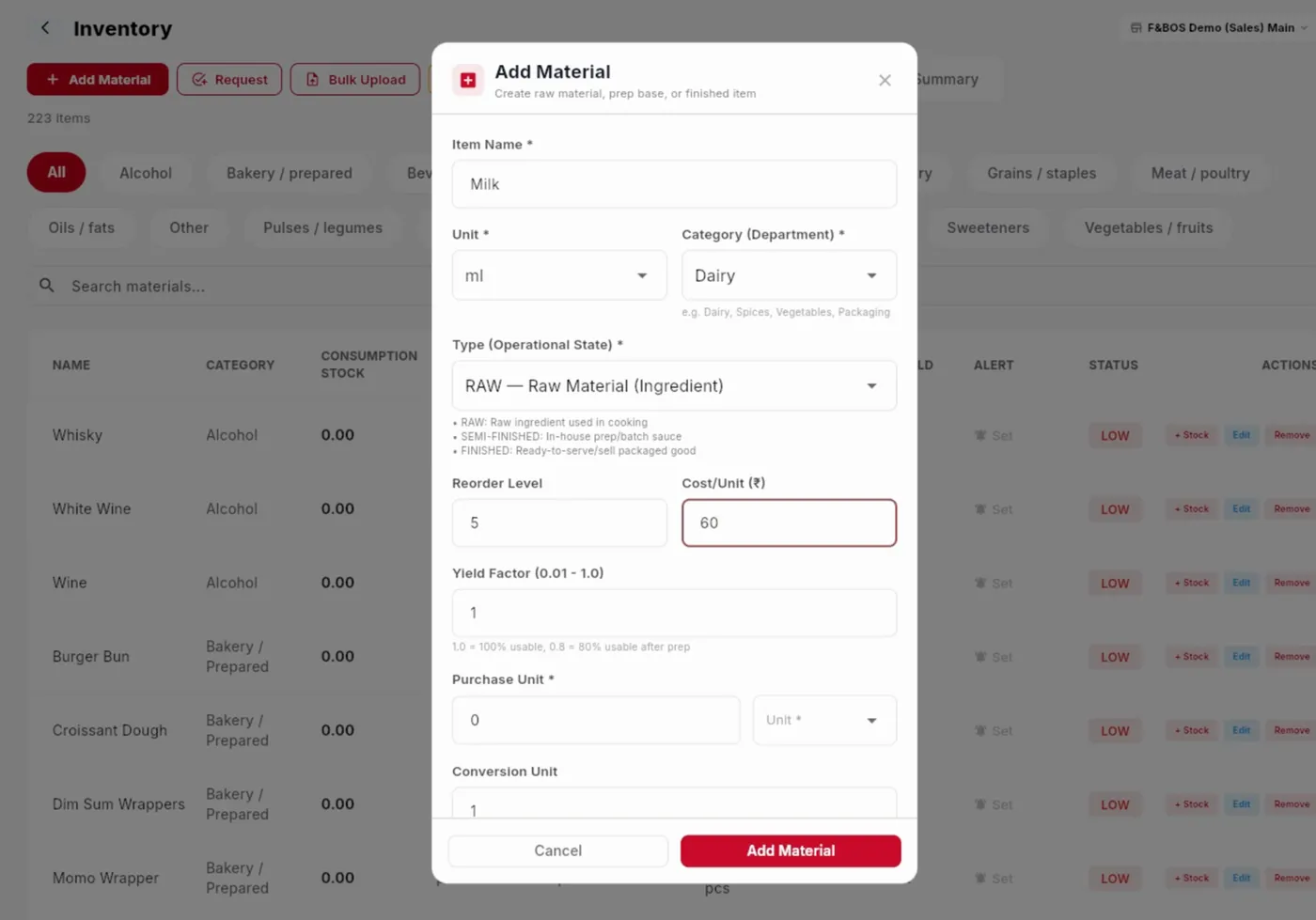
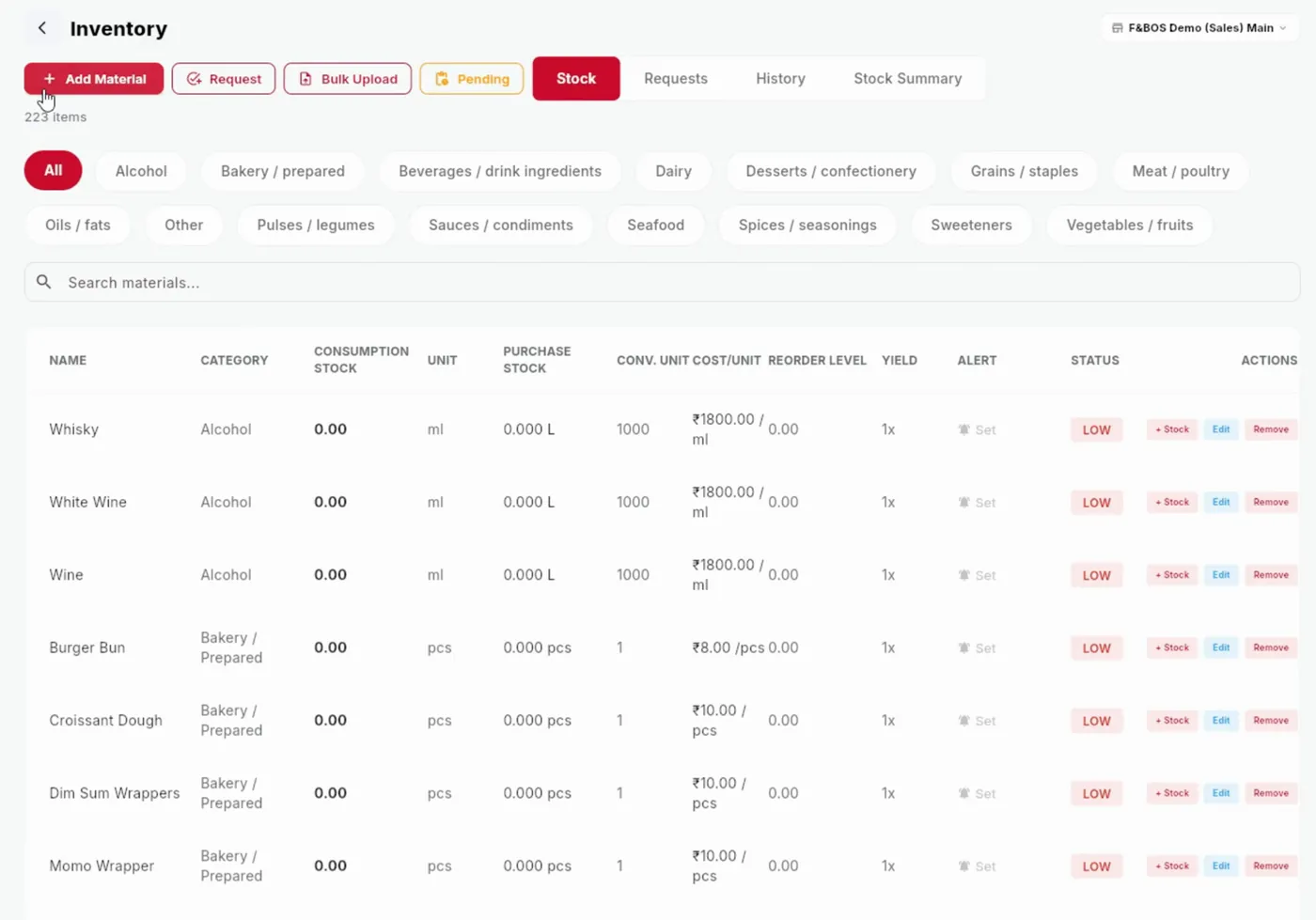
Real screens from F&Bos, taken from our setup videos.
What one plate of chicken biryani really costs
Illustrative prices; use your own. This shows why yield matters. If you buy whole chicken at ₹200/kg and 80% is usable after trimming, usable chicken really costs ₹250/kg.
| Ingredient | Per plate | Price | Cost |
|---|---|---|---|
| Chicken (usable, 80% yield) | 200 g | ₹250/kg | ₹50.00 |
| Basmati rice | 120 g | ₹110/kg | ₹13.20 |
| Ghee | 15 g | ₹650/kg | ₹9.75 |
| Onions | 60 g | ₹40/kg | ₹2.40 |
| Curd, spices and oil | — | — | ₹8.00 |
| Recipe cost | ₹83.35 |
At a menu price of ₹280, food cost is 29.8% and each plate leaves ₹196.65 before other costs. Two things change that number:
- Ignoring yield. Cost the chicken at the ₹200/kg you paid and the plate looks like ₹73.35, or 26.2%. That's ₹10 a plate you think you're making but aren't.
- A price rise. If whole chicken goes from ₹200 to ₹240/kg, usable chicken costs ₹300/kg and the plate costs ₹93.35, or 33.3%. At 60 plates a day, that's ₹600 a day, about ₹18,000 a month, on one dish.
A spreadsheet catches this only when someone updates it. In F&Bos, the new purchase price flows into the recipe cost and the dish's margin the same week. Try your own numbers in the food cost calculator.
Recipe costing in a spreadsheet vs in your POS
| Spreadsheet | F&Bos | |
|---|---|---|
| Cost of each recipe | Yes, if kept up to date | Yes |
| Yield and prep loss | Only if you add the column | Yield factor on each ingredient |
| Ingredient price changes | Typed in by hand | From purchase records |
| Stock used by each sale | No | Deducted on every bill |
| Ideal vs actual food cost | Month-end, if at all | Ideal vs actual variance |
| Margin across your real sales mix | Needs a separate sales export | MarginMind, from live sales |
| Cost | Free | From ₹9,500 a year (Basic + inventory pack) + GST |
A spreadsheet is a fine start for a small menu. Our guide to costing a restaurant recipe has a step-by-step method. Software pays off when prices move often, the menu is long, or you run more than one outlet.
What to check in any recipe costing software
| Capability | Why it matters | F&Bos |
|---|---|---|
| Gram-level recipes | Dish cost matches what goes on the plate | Yes |
| Yield factor per ingredient | Prep loss is costed, not hidden | Yes |
| Costs follow purchase prices | Margins stay current when prices move | Yes |
| Deduction on every bill | Stock and cost come from real sales | Yes |
| Ideal vs actual variance | Shows where food cost leaks | Yes |
| Margin per dish and menu ranking | Tells you what to reprice or retire | Yes, MarginMind (Pro and Enterprise) |
| Same system as billing | No exporting sales into a separate tool | Yes, one app |
| Multi-outlet view | Compare dish margins across outlets | Enterprise |
Recipe-linked inventory is included in Pro (₹15,000 per outlet per year) and Enterprise (₹24,000 per outlet, 3+ outlets). On Basic (₹6,000, up to 50 menu items) it's a ₹3,500-a-year pack. MarginMind margin insights are in Pro and Enterprise. Prices exclude 18% GST. See pricing.
Who uses recipe costing
Long menus
Find the dishes that sell well but earn little.
Thin delivery margins
Know each dish's cost before commission takes its share.
Milk and beans
Small over-pours add up across hundreds of cups.
Batches and weight
Cost by batch and by kilo when butter, milk and sugar prices move.
Read more: MarginMind AI · restaurant inventory management · the true cost of every dish · menu engineering · food cost percentage
Common questions
Which restaurant software shows the profit margin of each dish?
F&Bos shows each dish's margin inside the POS. Recipes are costed ingredient by ingredient with yields, every sale updates the dish's margin at current ingredient prices, and MarginMind AI ranks the menu by what each dish earns. Many POS systems offer recipe costing, so check whether their dish costs update when your purchase prices change.
What is recipe costing software?
Recipe costing software works out what each dish costs to make from its ingredients, quantities and purchase prices, then compares that with the menu price. In a POS like F&Bos, it also deducts ingredients from stock on every sale.
How does F&Bos handle yield and prep loss?
Each ingredient has a yield factor. If only 80% of what you buy is usable after trimming, the usable cost is higher than the purchase price, and F&Bos costs the recipe on that basis.
Do dish costs update when ingredient prices change?
Yes. Purchase prices are tracked over time, so a supplier price rise shows up in your dish costs the same week, and MarginMind updates each dish's margin at current prices.
How much does recipe costing software cost in F&Bos?
Recipe-linked inventory is included in Pro at ₹15,000 per outlet per year, or is a ₹3,500-a-year pack on Basic (₹6,000). Per-dish margins with MarginMind are in Pro and Enterprise. All prices exclude 18% GST.
Find out what your dishes really earn.
We'll show recipe costing, yields and per-dish margins with your own menu in a free 20-minute demo.
Book Your Free Demo →Free 20-minute demo · Free self-setup, or assisted setup from ₹2,000 · WhatsApp: +91 79803 72217